Myth and the Irish State by Regan John
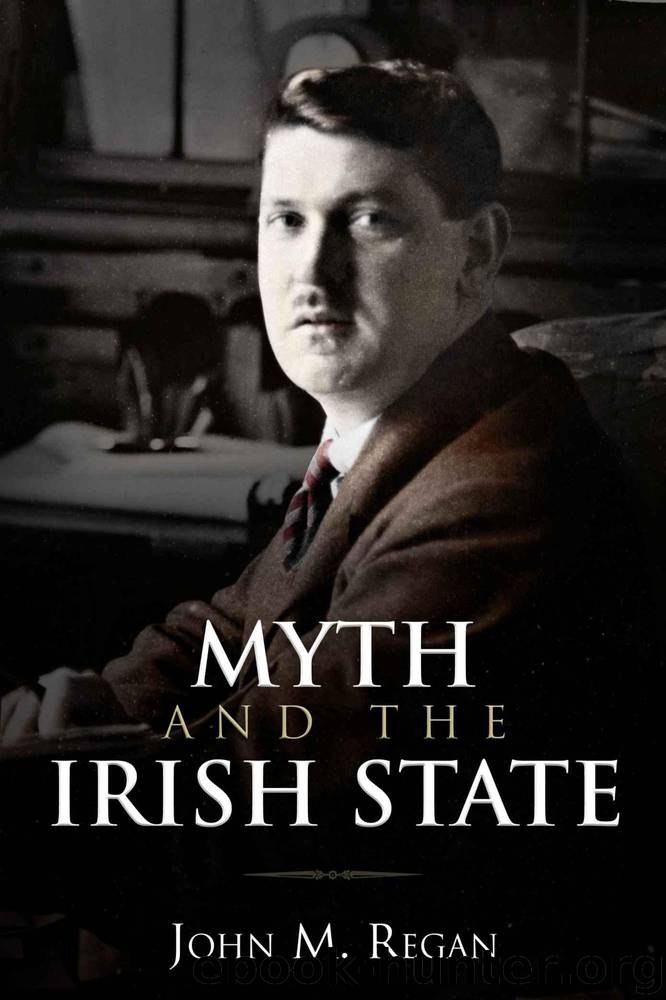
Author:Regan, John [Regan, John]
Language: eng
Format: mobi
ISBN: 9780716532552
Publisher: Irish Academic Press
Published: 2013-12-02T00:00:00+00:00
I
A somewhat tedious compilation of the whole mythological cycle of the Ogre de Valera – cold and austere, incorruptible, pedantic, obstinate, egotistic, the despair of his colleagues, the scourge of a suffering people – the figure familiar to the readers of the English press.13
So Dorothy Macardle described Denis Gwynn’s biography of Eamon de Valera in an Irish Press review in March 1933. Macardle went on: ‘the biographer is a persecutor, remorseless in his demands on those who may be able to supply him with facts’. Gwynn, it would seem, had been less than diligent in his researches, or at least in not consulting the inner circles of de Valera’s Fianna Fáil party. That said, Macardle was not alone in describing biographical method, but also her own approach to history writing and, moreover, the study of the period c.1911–25, which she published in 1937 as The Irish republic.14 In just over a thousand pages, Macardle vindicated de Valera’s career.
Macardle’s Irish republic delivered a public history borne of the struggle for independence. Offering a coherent, scholarly, republican history, the first three editions sold four thousand copies.15 There is no gainsaying that the research remains impressive. A dense narrative is driven forward with enormous documentation marshalled by academic apparatus. Independently, Macardle anticipated many of the up-to-date methodologies associated with the journal Irish Historical Studies, launched in 1938. By contrast, the Irish republic, despite Macardle’s denials, was unavoidably partisan in its purpose. Macardle’s favoured narrative was the pursuit of the revolutionary republic’s nation state, and whatever about shared faith in empiricism, this legitimisation of an overtly political objective arguably set it apart from Irish Historical Studies’ new departure.
In Macardle’s history, de Valera personified the revolutionary republic and the ongoing search for its fulfilment. For most of his political life, de Valera appeared to foment a discontented nationalism by employing what John Bowman has called the rhetoric of ‘inevitable unification’.16 This sometimes raised partition as an electoral issue17 but did not at any time form constructive policies intent upon remedying it. Rather, de Valera’s irredentism is best understood as an attempt to monopolise the issue, forestalling extra-constitutional ambitions in that quarter. Understanding the importance of the border’s stability for the mutual security of Irish polities North and South, quietly de Valera conceded the need for its existence – until, that is, the right circumstances would somehow arise to end it.18 Like many of his generation, for practical purposes de Valera was ‘a twenty-six-counties man’ dedicated to the existing state before all else.19 For some, this remains contentious, but in 1921 de Valera secretly20 – and in 1925 the Free State government publicly – argued that partition, while not ideal, had to be accepted.21
Anti-partitionism reinforced the border by exacerbating unionist Ulster’s paranoia, while the institutionalisation of Roman Catholic theology and the Gaelic language in the Southern state widened the gulf between North and South.22 De Valera cannot have failed to notice this. But by uniting separatists in the belief of the border’s injustice, de Valera manipulated partition as an issue transcending divisions existing between separatist-nationalists.
Download
This site does not store any files on its server. We only index and link to content provided by other sites. Please contact the content providers to delete copyright contents if any and email us, we'll remove relevant links or contents immediately.
| Africa | Americas |
| Arctic & Antarctica | Asia |
| Australia & Oceania | Europe |
| Middle East | Russia |
| United States | World |
| Ancient Civilizations | Military |
| Historical Study & Educational Resources |
Room 212 by Kate Stewart(5136)
The Crown by Robert Lacey(4825)
Endurance: Shackleton's Incredible Voyage by Alfred Lansing(4792)
The Iron Duke by The Iron Duke(4370)
The Rape of Nanking by Iris Chang(4228)
Joan of Arc by Mary Gordon(4121)
Killing England by Bill O'Reilly(4015)
Say Nothing by Patrick Radden Keefe(3994)
I'll Give You the Sun by Jandy Nelson(3455)
Shadow of Night by Deborah Harkness(3382)
Hitler's Monsters by Eric Kurlander(3355)
Mary, Queen of Scots, and the Murder of Lord Darnley by Alison Weir(3220)
Blood and Sand by Alex Von Tunzelmann(3210)
Eleanor & Park by Rainbow Rowell(3191)
Darkest Hour by Anthony McCarten(3138)
Margaret Thatcher: The Autobiography by Thatcher Margaret(3090)
Book of Life by Deborah Harkness(2947)
Red Famine: Stalin's War on Ukraine by Anne Applebaum(2943)
The One Memory of Flora Banks by Emily Barr(2872)
